Tuesday, September 26, 2006

Visit to Curacao

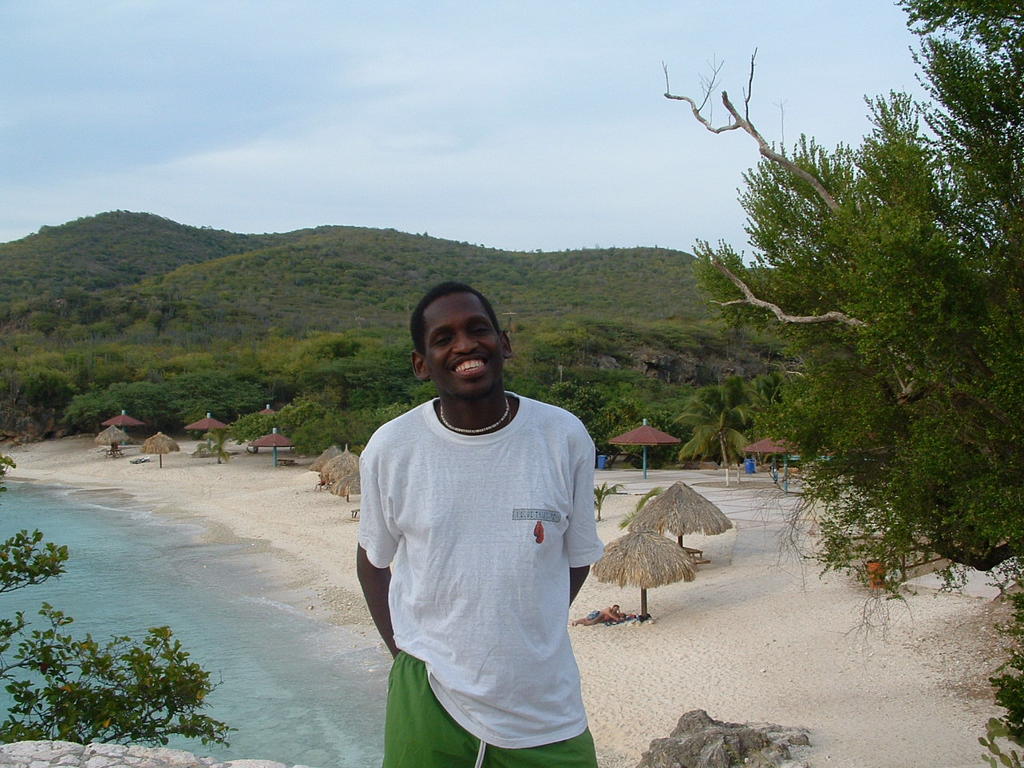
I just came back from Curacao where I passed two very nice weeks. I rested, partied, visited friends and family and worked on a very exiciting project. I will inform you about that project in the future.

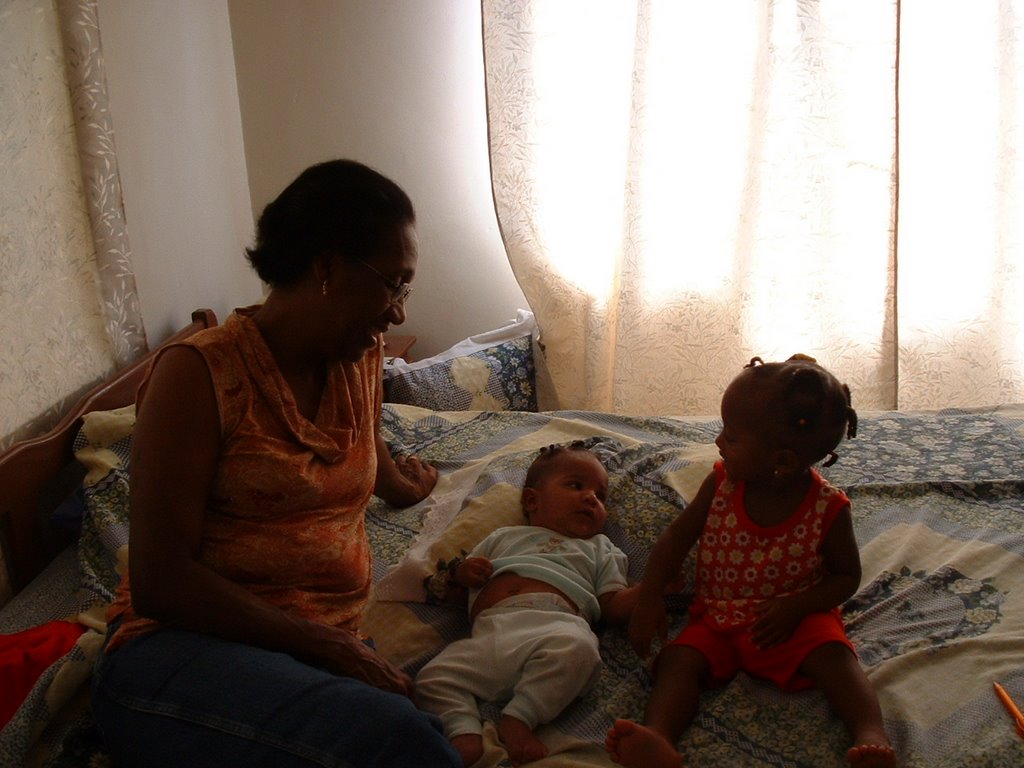
My mom together with my niece Jaylienne. After she stared at me for three days when I arrived, we became best friend. I'm already missing this nice girl, whom I have know since here birth in Almere. Now she is living in Curacao.

Here my mom with the children, Jaylienne and the youngest one Jurion.


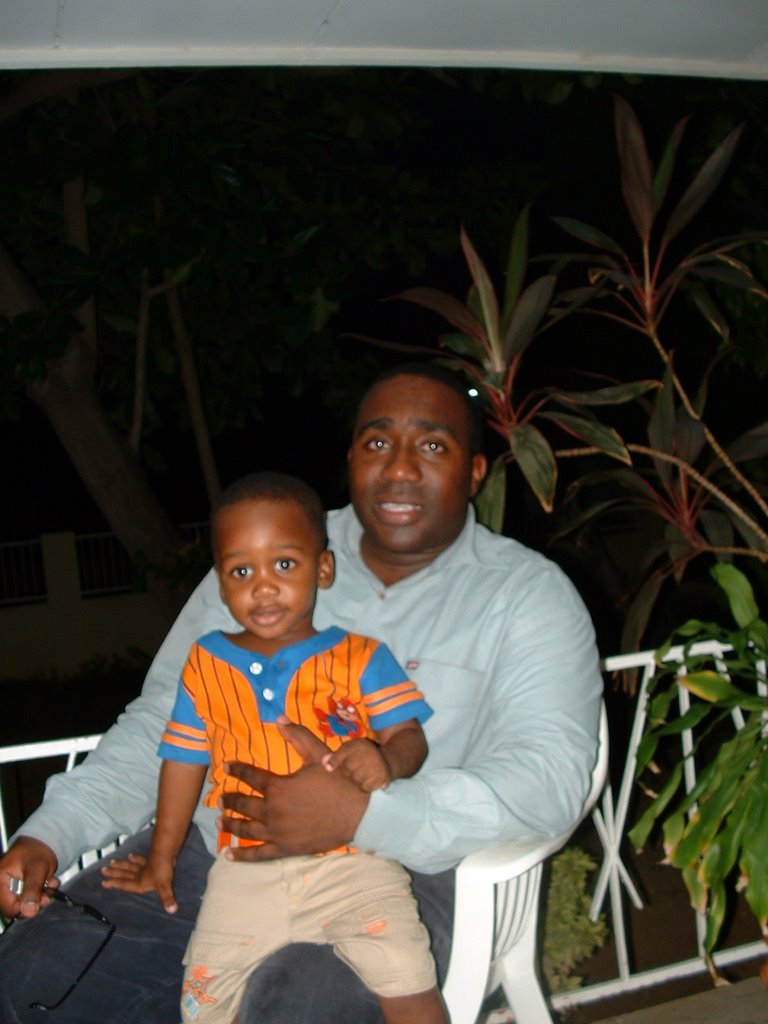
My cousin Robert, who moved back to Curacao last year visited a couple of times with his son Jayven.


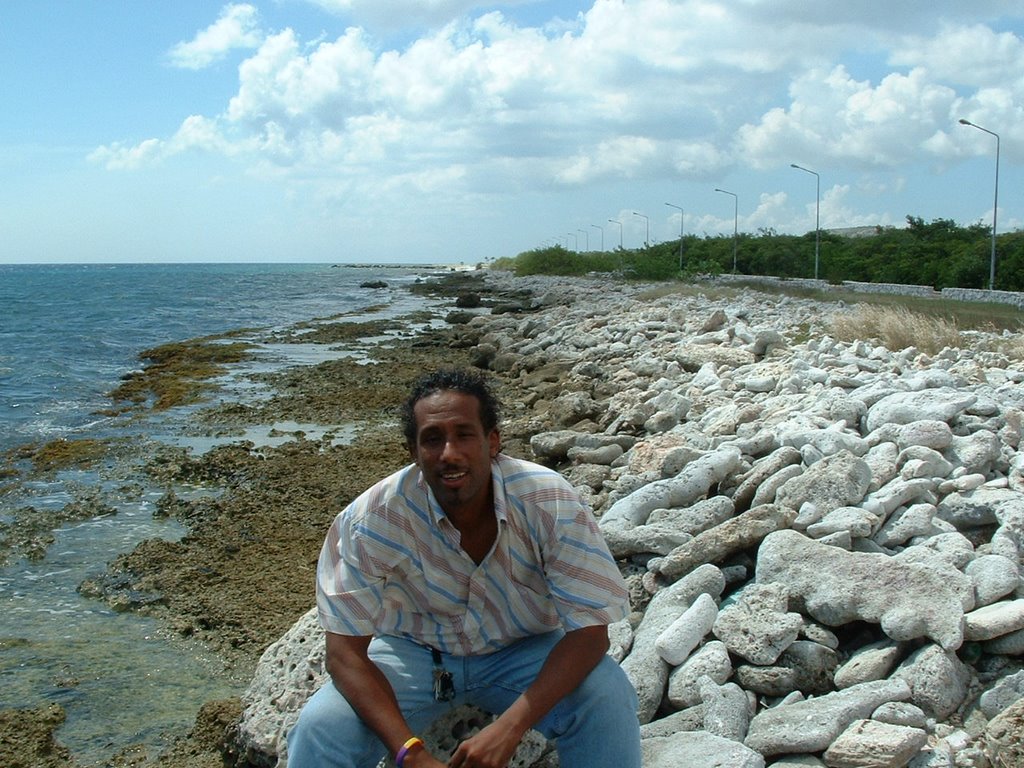
My dear friend Mario toured me on the island and took me parties during the Get Wet Weekend organised by local gay organisations.

I also visited the house where my father grew up, the central house of the Reina family.

I stayed in the house where I grew up. Now my mother's house.

Monday, August 21, 2006

The Kerwin Duinmeyer conmemoration

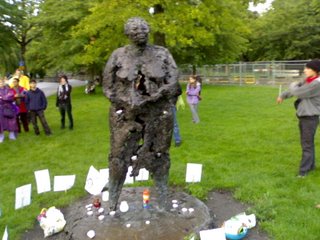
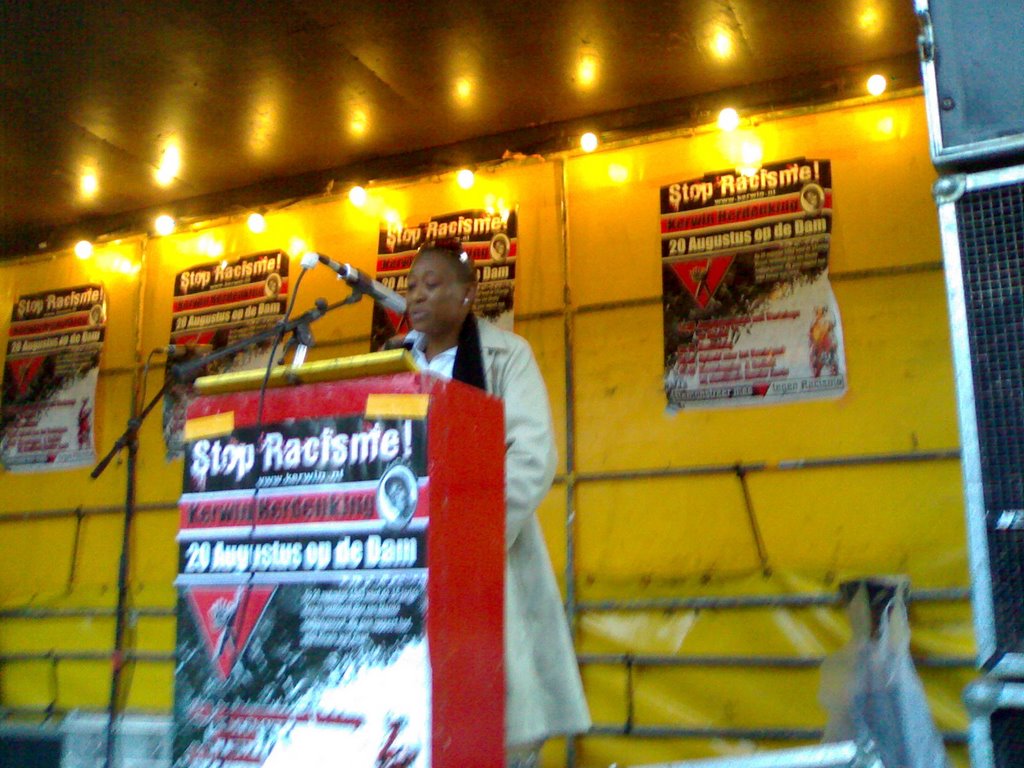
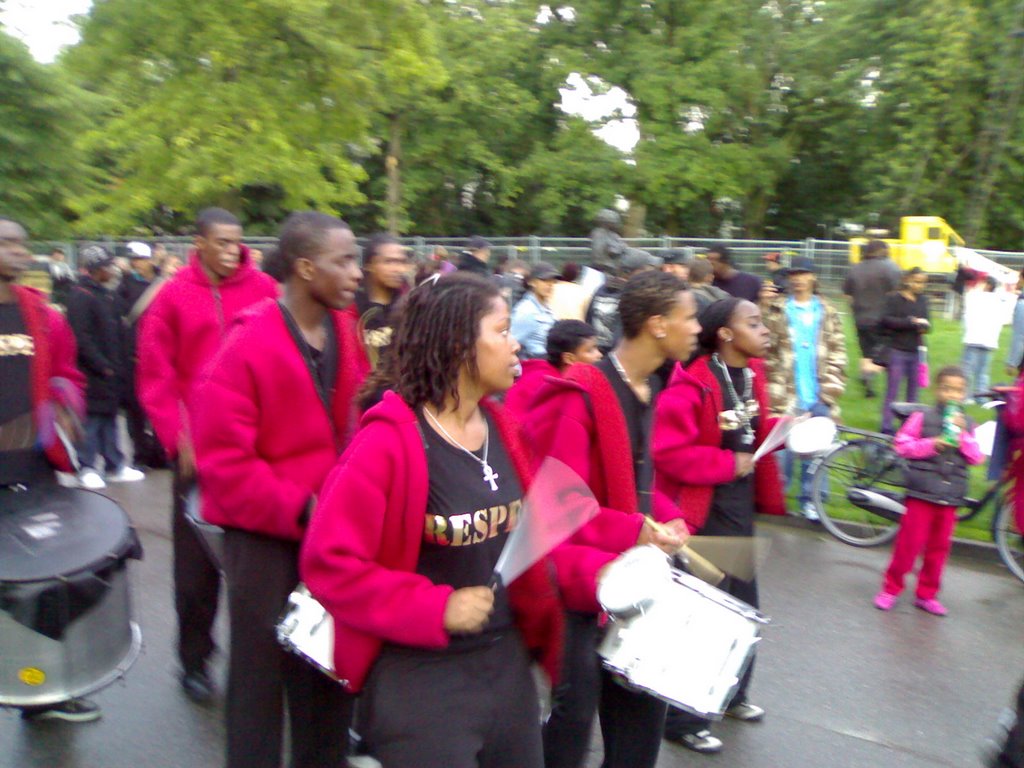
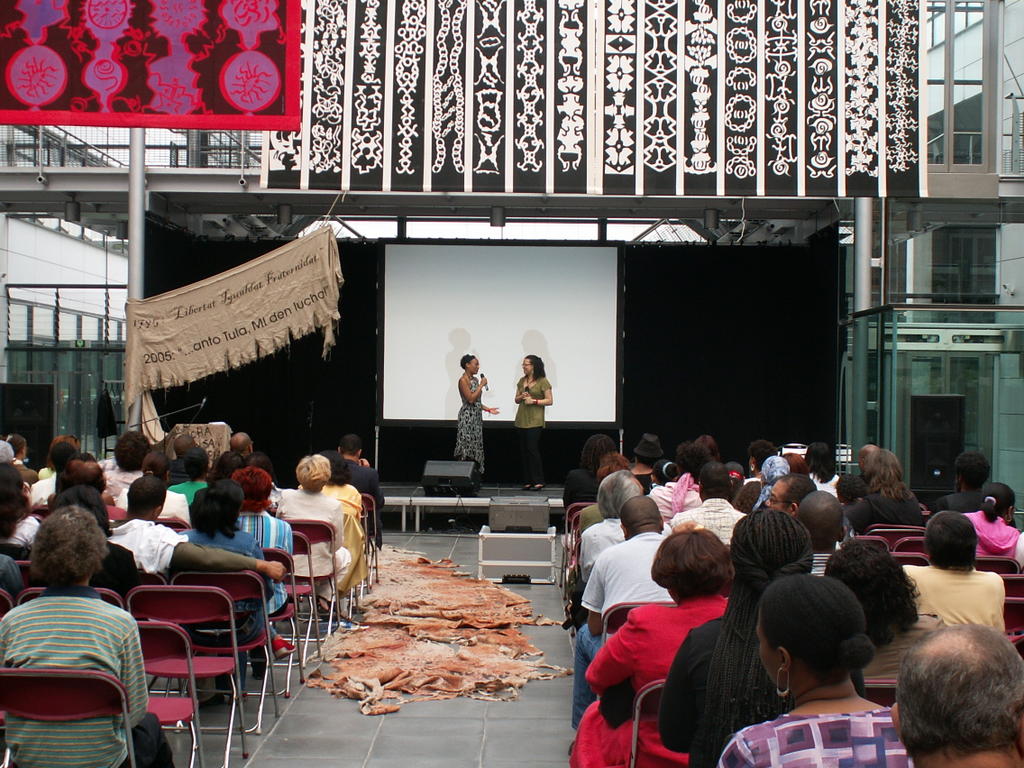
On August 20th 1983 the young Kerwin Duinmeyer was killed in Amsterdam. The killer was a fascist who killed him because of the colour of his skin. Duinmeyer became the symbol for anti-fascism in the Netherlands. Each year, his death is remembered with a manifestation, cultural performances and a quiet moment at a the sculpture Mama Baranka (Mother Earth) in the Vondelpark.


This year the demonstration took part for the 23rd time and people are always guessing about the public attendance. Is the amount of people a sign that people don’t care any more, or is it to much time ago, 23 years.
I visited the event together with friends. Our friend Christa Toppenberg, a very talented and renowned poet from Curacao performed with her own poems and with work of other authors.


The fact that Dijnmeyer was form the Antillean, always inspire the question why there aren’t more people from the islands taking part in the event. I think there are a lot of reasons as to why the participation of Antilleans is low in the Kerwin Duinmeyer- commemoration. At the other hand, a big part of the performers were Antillean, some, like some members of the drumming band Kalentura were very young Antilleans.


Each year when I visit the commemoration I feel a need to get involved. Fact is I have not!
I must find a way to get involved because of a lot of reasons.
I think it’s important to pay attention to the killing of a young, innocent man by a racist lunatic.
I think it’s important to make a big stand against racism in the Netherlands, a country which arrogantly have the idea they’re not racist. The French are, The Germans are, Italians, Spanish, American. The whole world could be racist, but they… not.
I still believe in the power of activism. I believe that another world is possible, if we can convince the people of it!

Listen to a radio-report (Dutch spoken) by the Radio Nederland Wereldomroep.

Saturday, August 19, 2006

Churandy Martina making Curacao proud!

Netherlands Antilles' Martina can be the best, says coach Kitchens
Tuesday, April 18, 2006
by Gary SmithCaribbean Net News Sports Correspondent

EL PASO, USA: Following impressive performances in the outdoor campaign so far this season, Bob Kitchens, head coach at the University Texas at El Paso, believes with a little maturity and technical work Netherlands Antilles' world-rated athlete Churandy Martina can become the best sprinter in the world."Churandy (Martina) is further along at this point than I thought he would be," Kitchens told Caribbean Net News on Monday, "but I do believe he has a lot left that he can do."I believe he has a chance to be one of the best sprinters, if not the best sprinter in the world."At the UTEP Invitational at the Kidd Field in El Paso, Texas on Saturday, Martina improved his personal bests on his way to winning the sprint double with record breaking performances. He clocked 10.04 seconds to claim the 100m and 20.27 for the 200m title, but despite blowing away the field in both races, Kitchens said technically the Islander still has a lot of work to do - noting this will only make him faster."None of the races (this season) have been technically correct and therefore it would lend oneself to believe that he can run faster in both races (100m, 200m)," Kitchens said. "I think he is further along in the 100m and it is probably his best event. He definitely has more than one gear, but again for these things to happen he has to mature as a runner and that will take a little time."Martina has already run 10.17 and repeated 10.04 performances for the 100m in addition to his 20.27, which left many track and field supporters with the belief that he will burn out early and struggle to keep his present form in the future.However, Kitchens told Caribbean Net News that the sprinter's performances are a result of his talent and assured the public that the Antilles star is in good hands."We do have a history of good sprinters in this program," he confirmed. "He (Martina) has as much talent as any sprinter we have had here and that includes (Olapade) Adeniken (of Nigeria) and (Andrew) Tynes (from the Bahamas."We do quite a bit of base work in the fall and I don't believe he will burn out any time soon."He is an exceptional young man that has his head down to earth and is easy to coach."Martina is now the second fastest over the 100m this season behind Jamaican world record holder Asafa Powell's 10.03. After claiming top in the 200m with his 20.27 performance, Martina now trails American Xavier Carter, who leads the world with a 20.13sec run achieved in a head-wind."The atmosphere is very good for training and I am doing my best," Martina said. "I just want to keep improving in both the 100 and 200 every week."In the meantime, at the UTEP Invitational Erma Gene Evans also of the University Texas at El Paso, broke the Saint Lucia national record and improved on her personal best to win the women's Javelin Throw with a mark of 54.19m. Evans' performance ranks her as the second best thrower in the school's history and is fifth in the NCAA in this year.

Friday, August 11, 2006

My ol' bud Bongane wins gold medal!

In this edition of "Keeping It Real" Joe Hawkins interviews two-time Gold medalist Bongane Nyathi, who won a Gold and a Bronze medal in the 2006 Gay Games in Chicago. Bongane also discusses his inspirational journey from South Africa to America and the motivation behind his winning attitude.

See the interview, thanks to 'Keeping it Real'
Marlon Reina

Sunday, July 30, 2006

Go for your dreams!


Today a the Kwakoefestival, (annual Afro Surinam festival with sports, food and music) I met Manolito, a guy I’ve known since kindergarten in Curacao. I haven’t seen him for more then ten years and after talking about our lives he asked me what I was doing.
When I told him I was working at a theatre, he was very surprised. He told me he remembered me as a very young guy drawing theatre curtains, theatre lightning, microphones and singers and dancers performing. He said ´You are realising your dreams´.

It was very touching to hear him say that, because I never realised that. I ´forgot´ about those dreams as a young boy. But I truly believe that at the end, what really make us happy is realising our dreams. And I think that as a young child, you can dream more freely, so to everyone go back to the dreams you had as a little child and realise them. You didn’t have those dreams just to have them. Dreaming is the way you can see everything you can become and realise in the future.
Thank you very much Mano and please do the same!

Tuesday, July 11, 2006

Modern dance from Africa

Last week I visited the program called Danse Afrique in the dance festival Julidans here in Amsterdam. During Dance Afrique we saw three performances by modern dance performers form Africa, whoa are touring Europe after winning an African modern dance concourse. The three pieces were very inspiring, beautifully danced and original.

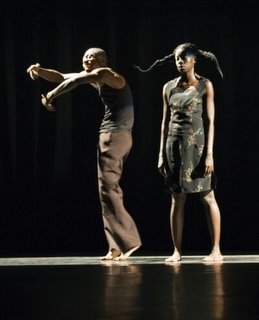
The second piece we saw was called by the choreographer Andréya Ouamba from Senegal. She danced in it too. On stage there were a couple, seemingly living on the street in cartons. The dance was a kind of a battle between the man and the woman, with expressions of fear, loneliness, attraction and reclaiming own identities. The way they moved was very staccato, with short movements with strange bowing of arms and legs. I liked it very much. This was for me the best dance of the evening.

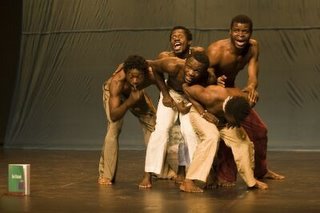
I also liked the group Mona- Mabu (Li Sangha company) from Congo a lot. They danced a choreography by Orchy Nzaba about daily life in the community, with a lot of familiar things like drinking beer together, playing and having small discussions. All of this danced in a nice rhythmical choreography by a group of five dancers. The group was completed with a storyteller who narrated and performed with the group.
It was nice to see professional dancers from Africa doing their modern dance, with a very own style. It was modern dance, but it wasn’t a copy of what you will see in Europe. And it was African, but it was not the traditional African dance we all know so good, and like a lot too. It was something new and beautiful, modern and African.

Wednesday, June 28, 2006

Ghana out- Brasil only people of African descent in Worldcup

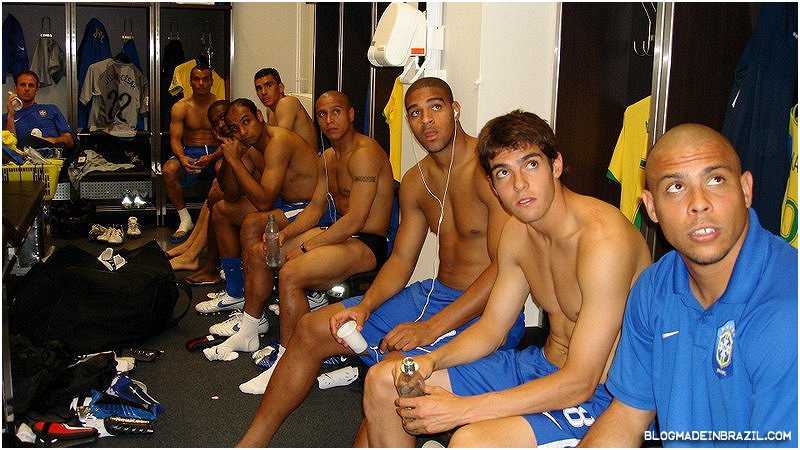
The Brazilian selection after the match with Ghana.
Appiah after the match.

Sunday, June 18, 2006

Bob Harms: praise for Oduber's public admiration for President Chavez his social policy


Today I post a column by the journalist and columnwriter Bob Harms about the way the Venezuelan president Hugo Chavez is potrayed in the media. He praises the Aruban prime minister Nelson Oduber for not letting the lies told in the media keep him for expressing his admiration for Chavez' social politics.


Bob Harms in La Prensa
Un pal’i hòmber!

No ta tur biaha mi por uni mes ku pensamentunan di promé minister di Aruba, Nelson Oduber. Pero un kos ta sigur. E ta manera ta bisa den bon papiamentu, un pal’i hòmber!

Miéntras ku na Kòrsou tur hende ta bira “diplomátiko” ora nan ta papia di presidente di Venezuela, Hugo Chavez i su gobièrnu, promé minister Oduber si ta sali i para manera un hòmber pa loke e ta pensa. E loke e presidente demokrátikamente eligí di Venezuela ta hasiendo pa e klase marginá di su pais, ta kos di apresiá, punto! Inkreibel ku na aña 2006 ainda tin hende spantá pa e zumbi di komunismo. Ainda tin hende ta kana rònt den e reino ku nos ta biba aki ku pensamentu di temp’i kouchiboulo ku si un hende ekspresá palabranan di apresio pa un persona òf movementu di tendensia sosialista, e persona aki ta un komunista òf anti Merka.

Loke ètól no ta yuda ta prensa internashonal dominá pa interesnan komersial merikano. Esun ku ta limitá su mes na sigui notisia for di fuentenan manera CNN, FOX News, Venevision, etcetera lamentablemente ta haña informashon parsial i distorsioná di loke realmente ta pasa na Venezuela. Un ehèmpel klásiko ta e supuesto persekushon di periodistanan na Venezuela. Direpente prensa internashonal ta yen di informe tokante supuesto persekushon di periodistanan na e pais bisiña. Sin ku niun hende por produsí un gota di prueba verídiko, tòg ta reina e impreshon ku na Venezuela no tin libertat di prensa.

Wèl, nada ta mas leu di bèrdat. For di dia ku Chávez a sinta kasi 8 aña pasá, nunka ainda a arestá un periodista venezolano pasobra ela skibi kontra Chávez. Ta bon pa menshoná, ku grupo Cisneros, doño di medionan di komunikashon gigantesko manera entre otro Venevision i DirectTV, ta operando ketu bai for di Venezuela, sin ningun estorbo di parti di gobièrnu venezolano. Anto tur hende sa ku Venevision ta enemigu deklará di Hugo Chávez, su gobièrnu i movementu polítiko.

Loke tur hende aparentemente a lubidá tabata kon eks presidente Carlos Andres Perez si tabata pèrsigui periodistanan na Venezuela. No laga nos lubidá 1992, tempu di e gòlpi di estado frakasá ku Chávez mes a enkabesá. Desena di periodista a bai sera i hasta torturá e tempu ei pa funshonarionan di polis sekreto DISIP, bou di mando di e ‘famoso’ comandante Henry Lopez Sisqo riba órden di Carlos Andres Perez. Si, e mesun Lopez Sisqo ku a fusilá e dos sekuestradornan di e avion di Aeropostal den e mardugá dramátiko di djamars 1 di òktober 1984 na Hato. Por sierto ku Carlos Andres Perez ta e úniko dirigente polítiko, “demokrátikamente eligí” ku Sosiedat Interamerikano di Prensa (SIP) a kondena pa e manera kon e la pèrsigui periodistanan na Venezuela.

No shonnan. Si Chávez ta usa rekursonan ku suela di su pais ta produsí pa aliviá e situashon di esnan ku mas tin mester, ta kos di elogiá. Ta p’esei Dios ta bendishoná un pueblo ku rikesanan natural. No pa e grupito ku pa siglo i siglonan a prosperá ku sanger, sodo i lágrima di esnan pober. I si Nel Oduber tin e kurashi pa bisa esaki sin miedu, e ta un pal’i hòmber!

Te otro siman ku poder di Dios (Bo opinion, opservashon òf krítika ta bonbiní: bobharms@setarnet.aw )

Thursday, May 18, 2006

Gainan Fini: Transvestism on stage


Starting May 27, Gainan Fini will be playing at Teatro Luna Blou in Curacao. Gainan Fini is a Caribbean La Cage aux Folles. I know a lot of so called 'straight acting' gay man on the island will feel the need to keep on stating that they're not like that. That they're not 'women 'and will complain about the fact that only effeminate gay men get public space in the Curacao popular culture. It is true, that in popular culture there is 'space' for men to be homosexual if they act (and sometimes dress) in a feminine way. But it's also true that most 'normal' gay men wouldn't dare to go public with their sexuality. It's always the same discussion. It also happened in New York during the so called Stonewall Riots. The men that could pass for straight did that and blended in the crowd, and the transvestites stood there and fought with the police.


The same five courageous guys from Antillean descent did when they told their own story in the documentary Marival, by Felix the Rooy. At a viewing of the documentary in Rotterdam, again someone in the audience made the remark about this portrayal of gay men. The filmmaker De Rooy was present and remarked correctly that those guys were ready to tell their story in front of the camera, something most other wouldn’t.

Gainan Fini will be entertainment making fun of transvestites, but also a stage for some transvestites on the island to express themselves. I would go if I was on the island.
I must confess that another reason to publish about this play is the fact that my friend Vincent designed the poster, which I found very good!

Gainan Fini:
Gainan fini di Eligio Melfor ta e vershon di 'cage aux Folles' di Kòrsou. Den e komedia sumamente humorístiko aki, e mayornan di e pareha ku ta bai kasa, mester bin huntu pa sera konosí. Komo tata di e brùit ta un funshonario públiko di gobièrnu di masha haltu kategoria i kontakto, nan no por pèrmití, pa e haña sa ku e yònkuman ku ta bai kasa ku su yu muhé, su mayornan ta un pareha hòmber homoseksual. Pa e motibu aki un di nan dos mester bisti na muhé pa hunga ròl di mama. Aki tur e situashon di hilaridat ta kuminsá. Un komedia ku bo no por pèrdè.

Monday, May 08, 2006

Controversial gay soap opera grips Cuba

By Fernando Ravsberg BBC Mundo, Havana
A TV soap opera is generating controversy on the streets of Cuba and attracting a record number of viewers. The reason? It is about what until now has been a taboo for Cuban TV: homosexuality.


Rafael Lahera faced discrimination after acting in the soapIt seems to be the sole topic of conversation in the workplace and the neighbourhoods, even though many men insist angrily that they do not watch "that telenovela in which a married man 'discovers himself' through a sexual relationship with a male friend".
It is the first time that television in Cuba has dared to broach the subject. It never even screened Strawberries and Chocolate, a classic Cuban film about the marginalisation of gay people.

The soap - The Dark Side of the Moon - shows the problems a bisexual man faces in today's Cuba, including his friends' revulsion and rejection by his parents.
Yaser, the bisexual character, says: "Everything I sacrificed myself for, I have lost."
His friend and partner tells him he understands.

It is good for the people to be informed, so that youngsters are not tricked or trapped into that kind of thing, that homosexual thing
Raimara Casas
"I also lost the affection of my parents and siblings," he says.
It is dialogue like this that is creating a stir across the island. The two men are not shown having any physical contact "so as to avoid offending viewers".
However, some do feel offended, including members of a group of retired men who I spoke to in a Havana park.
"I don't watch it. My wife does, but I don't like it because of the rude things they say," one says.
Another says: "I cannot get used to it, because what we were taught when we were young was morally different."
Discrimination
A different view on the soap opera comes from Raimara Casas, who thinks it serves as a warning.

Some Havana residents say they find the soap opera offensive
"It is good for the people to be informed, so that youngsters are not tricked or trapped into that kind of thing, that homosexual thing," she says.
There are also people like Maria Nora, who think The Dark Side of the Moon is important because "it shows an openness on this issue that is not even found in foreign soap operas".
Actor Rafael Lahera, who plays Yaser, says that to broach "such a delicate subject in such a macho society" is an important step for Cuban TV.
But playing the leading role has not been without problems.
"People think I'm gay," he says. And, he adds, he has been turned down for acting jobs because employers do not want a role to be played by a homosexual.
Such discrimination is not unusual in Cuba, where in the 1960s and 70s homosexuals were sent to labour farms.
Today, gays and lesbians are socially isolated, the police harass transvestites and the government is refusing to authorise sex changes for transsexuals.
Maybe this soap opera will contribute towards changing that.
Wednesday, April 12, 2006

Role Models


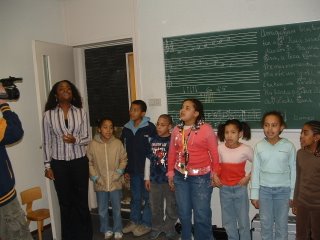
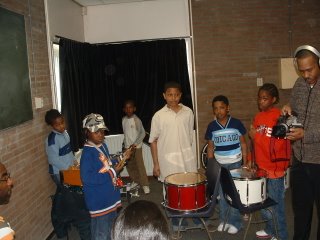
The Antillean community in the Netherlands is largely portrayed as criminals, rapists and irresponsible parents. It must not be easy to grow up as an Antillean in Dutch cities those days. A lot of people are putting their time available to give the youth good examples and teach them a lot for their own development. So is the project Luna Ku Solo, a musical program in the Bijlmer, where different Antillean music teachers give lessons to young children that wouldn’t normally go a music school. Praise to Mr.Eugene Boereveen, the initiator of this project. Today, April 12, the young musicians were visited by two big singers of Antillean descent, Edsilia Rombley, who represented Holland in the Eurovision song festival and the jazz diva Izaline Calister. It was very good to see the youngsters talking to their own role models.

The singing group singing traditional children songs from Curacao together with Izaline Calister, who told them she began singing at the age of seven in the children group Perlitas in Curacao.
Monday, April 10, 2006

Saint Gregorio Hernández

I was asked to present a poem at a Buddhist meeting about relationships. I looked through my writings and found this poem, or prayer. I called it San Gregorio Hernández.

Jose Gregorio Hernández ( 1864- 1919) was a priest from Venezuela who was very famous for his medical achievements and religiosity. He wasn’t declared saint by the Catholic Church, but a lot of people pray to him for health. So did my mother when I was born very weak, and she named me after him, Marlon Gregory. Funny thing is, that when I was lonely and put messages on so called sex lines, I used my second name: Gregory. That is what this poem is about.


San Gregorio Hernández

San Gregorio Hernández
Abo ku ta kura enfermonan
San Gregorio Hernández
Na abo nos ta roga
San Gregorio Hernández
Dòkter pa riku i pober
San Gregorio Hernández
Mi por puntra bo un kos?
San Gregorio Hernández
Mi tin sanger den mi kurpa
San Gregorio Hernández
Mi ke sinti..
San Gregorio Hernández
Brasa brutu rondó di mi.


English translation
Saint Gregorio Hernández
Thou, a man with a cure for our illness
Saint Gregorio Hernández
I address this prayer to you
Saint Gregorio Hernández
Thou, healer of the poor
Saint Gregorio Hernández

Saint Gregorio Hernández
Can I ask you a question?
Saint Gregorio Hernández
Blood is going through my veins
Saint Gregorio Hernández
I wanna feel...
Saint Gregorio Hernández
The embrace of strong arms.

Sunday, April 02, 2006

Spike Lee's new film


The director talks about making his biggest-budget film ever; his long working relationship with Denzel Washington; and his next project: a documentary on the response to Katrina.
Listen at National Plubic Radio.

Wednesday, March 29, 2006

Semana Gay Latino

Ojalá presenta: a program about youth and homosexuality in Latin Amerika.
The program is organised by Rebeldía Rosa, from the youth-organisation Ojalá from 3 arpil till 9 april. For this program 4 young queer activists from Latin Ameria have been invited to the Netherlands. All are figthing in their countrys for gay, lesbian, bisexual and transgedner rights. In the Semana Gay Latino there will be films, debates and a party.

Ojalá presenta: een week van activiteiten over jongeren en homosexualiteit in Latijns-Amerika. In de week van 3-9 april organiseert de groep Rebeldía Rosa van jongerenorganisatie Ojalá een week van activiteiten met het thema: Jongeren en homosexualiteit in Latijns-Amerika: GayLatino. We hebben hiervoor 4 jonge queer activisten uit Latijns Amerika uitgenodigd voor een bezoek aan Nederland. Allen zijn in hun land actief bij jongeren-organisaties die strijden voor de emancipatie van lesbo's, gay's, bi's en transsexuelen (LGBT's).

The program:
• Tuesday April 4/ Dinsdagavond 4 april 20:00-23:00: Discussionmeeting at the Political Cafe/politiek café De Klinker at De Grote Broek in Nijmegen. Adress: Van Broeckhuysenstraat 46, Nijmegen. Entrance: free.

• Wednessday April 5/ Woensdagavond 5 april 20.00-23.00 april: Discussionmeeting at Het Broeinest in the Plantage Dok Amsterdam. Adress: Plantage Doklaan 8-12, Amsterdam. Entrance: free.

• Thursday April 6/ Donderdagavond 6 april 20.30-23.00: Discussionmeeting in cooperation with Outsite at the space of Delftse Werkgroep Homoseksualiteit Adress: Lange Geer 22, Delft. Entrance: free.

• Friday April 7/ Vrijdagavond 7 april 22:00-04:00: Rebels Latin Queer Party with DJ Tía, Alternatieve Latino sounds (oa, salsa, regguetón, pachanga) among others. This is a benefitparty: so give extra money and drink a lot to support the Latin American LGBT- struggle. Location Club COC at Rozenstraat 14 in Amsterdam. Entrance : 5 euro.

• Sunday April 9/ Zondagmiddag 9 april 16:00-20.00:00: Salon Cine GayLatino with GayLatin films and a photo exhibition about crossdressing in La Paz Bolivia. After the movies there is space for conversation with the Latino activists. Location: Latijns-Amerika Centrum, Nieuwe Herengracht 29, Amsterdam. Entrance: free.

Macros Cipriano da Silva is 21 jaar en woont in Brasilia, hoofdstad van Brazilië. Brazilië is het land waar de meeste homofobe moorden per jaar plaats vinden (3 moorden per week). Marcos werkt hij aan een jongerenproject Cre Ser van organizatie Estruturação. Estruturação is vooral gespecialiseerd in het geven van rechtenonderwijs en het oprganiseren van de jaarlijkse Gay Pride.
Maria Zamora is 23 jaar oud en woont in Managua, hoofdstad van Nicaragua. Nicaragua is het enige land in Latijns-Amerika waar homoseksualiteit nog officieel bij wet verboden is. Maria werkt voor organizatie Grupo Safo. Grupo Safo richten zich voornamelijk op de emancipatie van jonge lesbische vrouwen en de strijd om het verbod op homoseksualiteit uit de grondwet te halen.
Jorge is 26 jaar en komt uit Lima, hoofdstad van Peru. Hij is werkzaam voor de organizatie Raiz para la Diversidad Sexual. Deze organizatie probeert studenten te motiveren zich op politiek vlak in te zetten voor de homo-strijd. De homostrijd is vooral een onderdeel van een bredere politieke strijd voor een betere wereld volgens Raiz. Ze proberen daarom aansluiting te vinden met Peruaanse vakbonden en politieke partijen.
Pedro is 29 jaar en komt uit La Paz, Bolivia. Hij is daar lid van de organizatie La Familia Galan. La Familia Galan is een groep transformistas oftewel transgenders en travestieten. Zij proberen door hun aanwezigheid in het openbare leven de samenleving de tolerantie ten opzichte van travo's te vergroten. Mocht je ooit in La Paz in een van de vele demonstraties een travo op stelten tegen komen dan weet je: es La Familia Galan.

Deze jonge LGBT activisten zullen samen met Ojalá proberen de problematiek van LGBT jongeren in Latijns Amerika onder de aandacht te brengen. Daarom woren in de GayLatino-week een aantal info-avonden georganiseerd met als afsluiting een Super-Cool-Queer-Latino-Party op vrijdag 7 april. Ieder info-avond zullen de activisten vertellen over hun werk en in discussie gaan met Nederlandse homo-activisten. Natuurlijk is er uitgebreid de ruimte hen vragen te stellen. Ook is er iedere avond een Latino-Gay film en een foto expo over travestie in La Paz. Kortom: een unieke kans op een ontmoeting met de Latijns-Amerikaanse queer-actie scene! Viva la primavera con la Rebeldia Rosa!

My first staged play


I've written different pieces for magazines, the radio, and a lot of poetry. But last weekend my first piece of theatre was satged by a group of young people in Amsterdam, directed by Raymi Sambo. The story was an idea of Raymi Sambo. I thank him a lot for his trust.


Thursday, March 02, 2006

Karnaval 2006

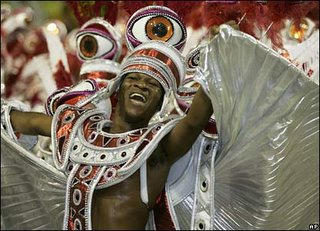
I was raised with Carnival, called Karnaval in my native Curacao, and will allways adore this celebration!


Rio de Janeiro


Curacao


Trinidad & Tobago


Curacao


Rio de Janeiro


Aruba


Curacao

Saturday, January 21, 2006

What kind of a rebel are you?

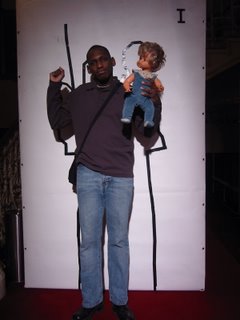
Last week I visited a ‘performance’ of the theatre organisation Urban Myth, where the organisation’s founder, the young actor Jörgen and a DJ receive guests in the lobby of the prestigious Municipal theatre Stadsschouwburg. The program this time was dedicated to Revolutions. Talking with young and more experienced rebels the two hosts explore the reasons why till the eighties people seemed to rebel more easily then during the last years. The audience could participate too in a photo shoot. There were three prepared figures of a kind of rebel on a board, and the audience could choose which kind of rebel or Revolution they felt more attached to. I choose this one:


Later we got an envelop with a description of the kind of rebel we were. I will translate for you what mine said, and gave my comments on it in yellow.

Power
To survive
I suppose I have this kind of power, I have never thought seriously about suicide for example. But I don’t see my self as a model of Power, which I connect more with physical strength.

Powerful rebel,
Freedom, equality and brotherhood (Liberté, Equalité et Fraternité) are very important to you.
That is true, these were also one of the inspirations for the Big Slave Rebellion of 1795 in Curacao which I’ve been commemorating in Amsterdam.

You are a born leader, but can also be a good follower. For you there is no mountain too high, you will do your utmost to achieve your goals.
This is more the person I’m becoming today. In the past I wasn’t always good in touch with my dreams and goals, so I didn’t always try hard to achieve them.

Your body is your temple and for that reason you take very good care of you. Exercise, drinking a lot of water, each day evolves around yourself. Because the best men wins!
Wish this was true. Today I got home after working at 10.30 PM and had to cook my dinner at that time. I was tired, cold and miserable. I really have to learn yet to take good care of myself.

Some people sees this as a bad thing. But that is because they don’t realise you also need power and knowledge to be able to take care of others. Keeping the harmony can be trusted to you. Just Do It.
I think I’ve been doing this one.

Your role model: Oprah Winfrey
I have a hatred-love thing with Oprah. Sometime she really annoy me with her to obvious commercial praise for artist: ‘Oh, you are the best actor I know…’. But in other shows she reacts on people in the most mature way possible, and guide them to see their own realities in such a honest and profound way. No, Oprah is Top.

Your Link: nl.wikipedia.org
This is new to me .

Your action: adopt a chicken.
No, no no! In those senses I will always be a Curacao man. Animals are important, but don’t exaggerate.


I have to say Big Up to Hidde Simons who organised this part and sent me the picture I asked him.

Saturday, January 14, 2006

Tania Kross sings Curacao


Curacao born mezzo-soprano Tania Kross will perform a special program with songs of her native island Tuesday 17 January at the Muziekgebouw aan het IJ in Amsterdam.

Mezzosopraan Tania Kross is bijna altijd alleen maar te horen in allerlei operatheaters met de prachtigste aria’s. Maar er is nog een andere kant : haar Antilliaanse roots.
Juist omdat haar carriere zo voorspoedig verloopt, heeft het splinternieuwe en schitterende Muziekgebouw aan het IJ in Amsterdam Tania de kans gegeven om een programma samen te stellen met repertoire dat haar na aan het hart ligt, en dat hier in Nederland bijna nooit te horen is : muziek uit haar ‘eerste thuisland’: de Caraïben.

Ze heeft een pracht programma samengesteld met o.a. Bo tin ku bolbe (van René Clemencia), Soño di anochi en Nenita (van Emilio Prudencia), Chuchubi en Sunú (van Oswin “Chin Behilia), en natuurlijk Tantan Meri en Nonze su kantika di tambu, waarin allerlei mooie muzikale kanten van de Antillen belicht worden.

Tania zou niets liever willen dan al deze liederen te zingen voor mensen, die dezelfde warme gevoelens bij deze muziek krijgen als zij zelf. Voor mensen die weten waar de muziek over gaat. De warmte van de Antillen wordt dan ook voelbaar in de zaal, zodat iedereen ongetwijfeld blij naar huis gaat. Juist omdat deze muziek bijna nooit in een dergelijk mooie setting wordt uitgevoerd, zou Tania het geweldig vinden juist dit concert met u te delen.

Randal Corsen en Roel Calister en nog veel meer musici spelen mee. Tania kreeg hiervoor carte blanche van het Muziekgebouw.

Dit eenmalige concert vindt plaats op dinsdag 17 januari a.s. om 20.30 uur in Muziekgebouw aan het IJ in Amsterdam. Er zijn vast nog wel last minute kaartjes te krijgen, maar om goede plaatsen te krijgen is het verstandig van te voren de kassa te bellen op tel. 020-788 2000, en te reserveren.

Muziekgebouw aan het IJ ligt vlak achter het Centraal Station, en is uitstekend per auto te bereiken. Vlakbij is een ruime parkeergarage.

Wednesday, January 04, 2006

The best of 2005


On January 24 2005, my first niece was born: Jaylienne, daugther to my older brother Julien.

And on July 16 2005, my sister Sibelle married her long term friend, boyfriend and fiance Siji.

The worst of 2005


Two young men were killed in Iranbeacuse they were gay Authoroties declared they were punished for a rape case, a excuse oftenly used in cases where sons of rich and influential people get caught in homosexual acts. Read more at the site of the International Gay and Lesbians Human Rights Commission.

Friday, December 09, 2005

Christian Homophobia


In Holland, with the general anti-islam tendencies in society, a lot of right-wing people seem to be lying waiting for an act of homophobia done by Muslim people to publish it and start condemning Muslims. Fact is that homophobia has been and will stay in most societies. In some cases done by young men trying to proof their virility, in other cases by sexist men trying to own the sexuality of women in their surroundings, and in other cases it is condoned by religion. The three monotheist religions all condemn homosexuality, and people for different reasons will be aggressive towards homosexual people. In some cases people will be killed because of their sexuality. This happened this year a couple of times in Iran, which was given big exposure in the Dutch (gay) media. But December 1st this year for the second time this year an active gay men, Steve Harvey, has been killed in Jamaica, by people claiming to be Christians. Steve Hardy has been working in the HIV and Aids field in Jamaica.
Vey often, the murderers in Jamaica use the same arguments homophobic people in Muslim societies do: our religion doesn’t accept that and that gives us the right to kill a homosexual person. It is wrong, in all cases. Normal thinking people, like me, would say that each person has the right to live his life the way he chooses. And religious people that read the Holy Books should know that ‘thou shall not kill’ is also a very important passage in the same book.

Mr. Harvey, thanks for your courage and good work during this life. May God and all saints receive your spirit!

More information at Christian Aid

UNAIDS Condemns Killing of AIDS Activist in Jamaica
Geneva, 7 December 2005 -- UNAIDS condemns the recent killing of Lenford “Steve” Harvey, a Jamaican AIDS activist who, since 1997, worked tirelessly with the Jamaica AIDS Support to contribute to the response to the AIDS epidemic.
Steve Harvey’s death is a profound shock and loss not only to the AIDS movement in Jamaica and the Caribbean, but to the whole world. UNAIDS expresses its sincere condolences to his family, friends, and colleagues.

Steve Harvey will be remembered as an extraordinarily brave and committed activist, who, irrespective of the dangers of his work, represented the interests of people living with HIV and those at risk of infection. His courage was inspiring and his capacity to reach out to those in need outstanding, providing them one on one counseling, and access to HIV and AIDS information and services.

UNAIDS is confident that the Government of Jamaica will investigate Steve’s death to ensure that those who committed this hideous crime are brought to justice.
UNAIDS reiterates its support for the strengthening of efforts by the Jamaican government to address homophobia and other causes of stigma and discrimination, which are fuelling the spread of AIDS not only in Jamaica but across the Caribbean.

Legal and policy reform have an important role to play in ensuring that human rights of all are respected, and also in helping to change broader social values and in setting standards. It is freedom from fear and discrimi­nation that will finally empower individuals and communities to act, to mobilize their resources, and to respond collectively and positively to the AIDS epidemic.

Sunday, December 04, 2005

How I got to know Aids


On May 22 1997, during the "3rd International Conference on Home and Community Care for Persons Living with HIV/AIDS, Amsterdam, 21-24 May 1997" I had a retransmission of the radio program I was doing called Global Perspective at the local lesbian gay radio station MVS. Due to that reason, my colleague Andre and I decided to have the program in English and invited a participant at the conference as our studio guest. I had a personal column each month and for this special retransmission I wrote my column about how I learned about Aids as a teenager in Curacao. A couple of days later I do my share for the World Aids Day.


How I got to know Aids
It must have been during the ‘school vacations’ in July, when school closes for six weeks in Curacao. The year must have been 1983 or 1984. My cousin Sharela was spending the holidays with us. While all of us, my brother, sister and me, were young and innocent and just leaving primary school, Sharela was already at the ‘big children school’. She knew about things like sex and masturbation. And about how to get pregnant, or preventing that of happening. One night I was reading the evening newspaper and saw a picture of a man in a hospital bed. Another man was holding his hand. Sharela, our big cousin, read the article with the picture and lectured us in her way: ‘Oh, that man there is dying of Aids. He got ill!’


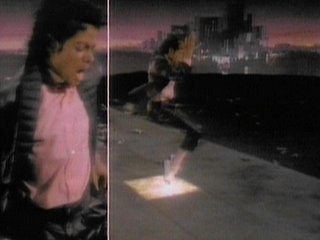
I asked Sharela what Aids was. She told me: Aids is a disease man that are homosexuals get!’ We put the newspaper away and continuing dancing, at the beat of Michaels Jackson’s Billie Jean. At the age of thirteen I was more interested in trying to imitate the dance moves of the video clip of Billie Jean then in a ‘disease man that are homosexuals can get’.
I didn’t know at that moment that the fact I loved watching other boys in swimming suits made me a homosexual. Aids became familiar to me before homosexuality did.

Maybe one year after the newspaper incident the Aids prevention campaign of the Curacao government started. A cartoon was published in the newspaper picturing a man and a woman flirting. At the end the woman says to the man that she would only do it with a condom. Because of Aids. Later the famous youth band Name made a song about it: Para Sida, e ta kibra bo bida/ Stop Aids, it ruins your life.


( Gabriello Cruz, singer Name)

I got acquainted with the disease, and the fact you could get it through sex.

It must have been years later, maybe after my migration to Holland in 1989, that I heard about risk groups affected by Aids etc. I became a homosexual and became sexually active and learned to use condoms. Sometimes I still remember the newspaper incident.
It is funny to see at this moment, that in my voluntary work, I’m working with the black gay group Strange Fruit, trying to set up a support group for black and migrant people infected and affected by HIV and Aids. The support group has started with social meetings and is called Together We Live!. Strange Fruit organized it together with the Amsterdam section of of the Dutch HIV Association.

I know now that Aids is not ‘a disease man that homosexuals are get’. But any way, Sharela, the cousin who knew it all, later became pregnant at a moment she didn’t wanted it. Even people that knows a lot, have more things to learn. So do I.

May 22 1997

Wednesday, November 23, 2005

35 th Birthday part 2


My dear friend Andre, whom took a lot of pics left early, so was missing on the picture on the first post about my 35 th Birthday. Here's Andre with me.


And below my bestfriend Judith, whom also left early with our Vincent.

Saturday, November 12, 2005

Power, hard to handle?

Talking about power-abuse and suppression has always been a tricky thing. One moment you're a victim, the next one you can be the perpetrator. It's wise to also take the next issue in account.
Amerindian fury at discrimination
Amerindians in Guyana have said they are being racially discriminated against by the country's two main ethnic groups, Afro and Indo-Guyanese.
These claims of racial discrimination come against the backdrop of a long history of strife between the two main ethnic groups which make up the majority of GuyanaÂ’s 700,000 citizens.
The Amerindians, Guyana's indigenous people have taken their claims of sexual, social, economic and political exploitation to the Ethnic Relations Commission.
Toney Jones, the Chief of Chiefs for Upper-Takutu/Upper Essequibo Administrative Region in southern Guyana nearer Brazil told BBC Caribbean Radio the alleged sexual exploitation of Amerindian females by Afro and Indo Guyanese, who they call coastlanders, is a major problem.
"When these police from outside - even our own indigenous brothers - come here, we need to know if they are single or if they are married," he said.
"Because they come here and say, 'I don't have a wife' and the next thing you know three or four children will come and the woman is left with the children for her to fend for them and this is not fair."
This raises the issue of whether the Amerindian women who are allegedly exploited are underage or are adults are engaging in consensual sex.

Education campaign
Ethnic Relations Commission chairman Juan Edghill said the allegations will be investigated but he doubts whether the Commission can do much if two adults have agreed to sexual intercourse.
He believes that much will depend on public awareness and education, targeting the Amerindian communities.
"That will be out of our jurisdiction. We can't get into adults' lives and tell people who to sleep with or not to sleep with," he said.
"If you like the headmaster or the police officer, the ERC can't come in and determine that if itÂ’s consensual," Edghill said.
"But if it's a case that we're seeing a widespread situation where men come in to communities, make children, disappear and it's a burden on the social services of that community to take care of those children then education and internal mechanisms would have to be approached, it canÂ’t be an ERC approach."
Mr Jones said the Amerindians are also tired of being exploited by politicians in the run-up to general elections a time he calls the 'Mango Season'.
His comments come as the country gears up for the 2006 General Elections and politicians are visit Amerindian communities to try and secure votes by making promises and showering communities with gifts.
"Politicians come here and all you hear is 'who bad, who this, who that' all the time in our communities, election after election," the Chief of Chiefs said.
"What you find is you have a divide, so in between elections, we're ok but when the elections are coming near, the divisions begin and that is not a healthy situation."
The Chairman of the Ethnic Relations Commission wants to see this practice come to an end, and urged the Amerindians to cast their votes based on issues.

Source: BBC.com

Wednesday, November 09, 2005

35 Birthday and Black Magic Woman Festival

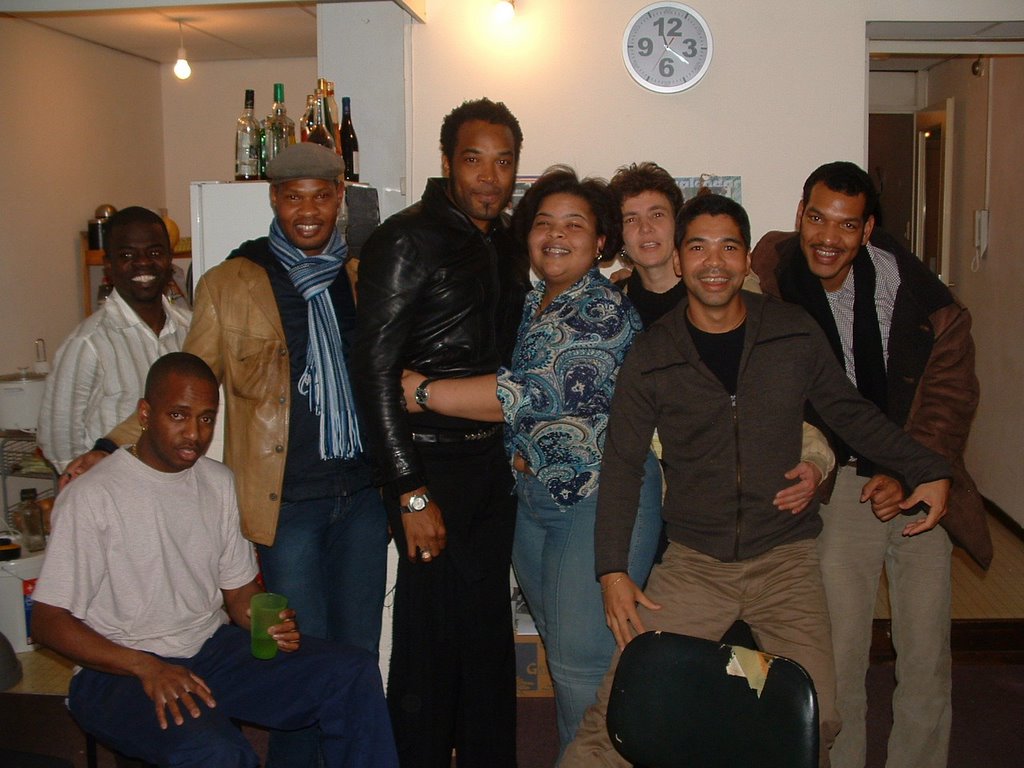
I celebrated my 35 Birthday last November 8 the. I was joined by my good friends and brother for this occasion. On the picture best friend Judith is missing and also Andre. They left earlier.
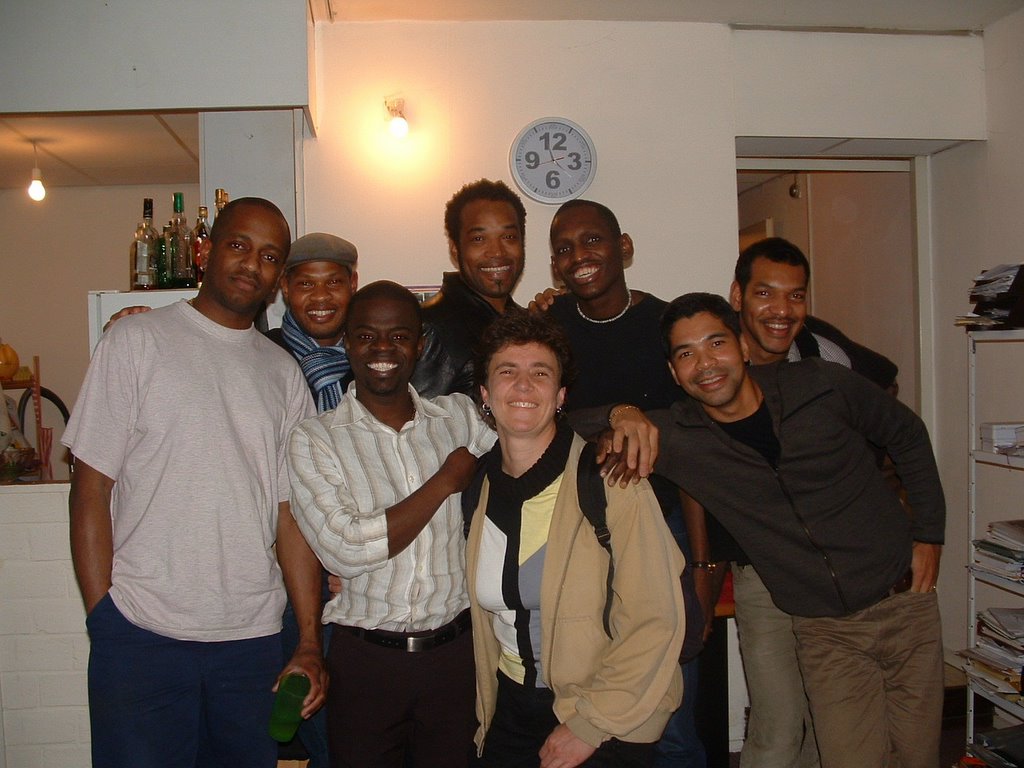
From left to right, back: Julien (bloodbrother), Ytel, Laurindo, me and Alexis; front: Collin, Barbara and Vincent, who was one week visiting from Curacao. The picture was taken by Jessica, with the blue shirt on the second picture below.


This Friday the Black Magic Woman Festival is starting on Friday with a concert by jazzsinger Denise Jannah with three singing guests. The festival, this year celebrating it's tenth anniversary, is the only festival in Holland with black women on the stage presenting different art forms: theatre, music, literature, visual arts, film and debate. More info


A very special guest this year is Valerie Mason-John, visiting from London. She has been invited to the festival due to her fiction debut Borrowed Body, a novel about a young black girl, growing up in fosterhomes in white Great Britain. She will be reading on the Poetry and Literature evening Tuesday November 15th. Tickets only 5,00 euro's, 020- 695 29 11

Saturday, October 15, 2005

Antillianen spelen De Zwarten

Antillianen spelen de Zwarten: The Antileans play The Blacks. The following piece is about a new intepretation of the famous play from Jean Genet. A play about the thoughs of whites about blacks and vice versa. The play is shown October 21 and 22 in Holland.

Antillianen spelen de Zwarten is een bijzonder stuk in de regie van Helene Pieter, waarin een groep Antilliaanse theaterspelers een absurdistisch stuk van Jean Genet op de planken zetten. Een stuk over zwarten over witten, en witten over zwarten. Ik heb het stuk kunnen zien april dit jaar en was aangenaam verrast. Niet alleen om de vaak aangrijpende spel van de (voor een deel) onervaren spelers, maar ook om de prachtige vormgever. De bekende beeldend kunstenaar Juan Carlos Tajes maakte voor deze voorstelling bijzondere maskers.


Onder de spelers zitten een paar bekenden. Mijn Tambú- collega Desiree Martis speelt erin, Sergio Belfor, de jongeman uit Rotterdam die zich kandidaat stelde voor het jongerenraad bij de Verenigde Naties en de beknde beeldend kunstenaar Rudy Martina.

De Antillianen spelen de Zwarten op vrijdag 21 oktober in Concordia in Den Haag.
Voor de voorstelling in Den Haag zijn er vanaf donderdag 13 oktober kaartjes à 13 Euro verkrijgbaar bij Toko Gouw, Rijswijkseweg 680, in Den Haag. Tel.: 070-4157755.

Op zaterdag 22 oktober spelen ze in Rasa in Utrecht.

U kunt luisteren naar een reportage van een repetitie, uitgezonden april 2005 bij de NPS Radio. Met dank aan journalist Mike Baal, die zijn site beschikbaar stelde, kunt u de reportage horen. Ga daarvoor naar http://www.mikebaal.nl/marlon.htm

Mike Baal werkt als journalist. Bezoek http://members.chello.nl/a.baal/index.html om meer over zijn journalistiek werk te zien.

Thursday, October 06, 2005

To be a terrorist!


Wednesday I visited a debate on the treatment of minorities by the Chinese government.
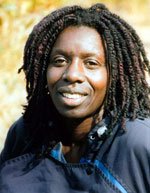
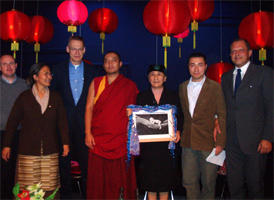
Mrs Rebiya Kadeer (centre with picture) was one of the speakers that intrigued me a lot. This lady was a respected businesswomen in the autonomous region where the Uguir people lives. The Chinese government call her a terrorist. This because she stands for the right of her people to talk their own language, have their own religion, and educate their children the why they choose.


On August 22 we commemorated the Slave rebellion of the slaves in Curacao that started on August 17th, 1795. The main leader was known as Tula. One speaker at another commemoration stated that if Tula lived today, he would be called a terrorist. I'm sure that would happen. It happened to Mrs Kadir. The people in power decide which acts are terrorists ones, and which are official 'performance'. Mrs Kadeer was put into prison for her activities (as was Nelson Mandela, to mention just one). The Chinese rulers have the legal right to label her activities as terrorism, to judge her and they also imprisoned her. The same happened to the slave rebellion leader Tula. At the end he was killed. The Dutch colonial rulers in Curacao at that time had the right to call him a 'rioter', to judge him and his companions and to kill him, in a very cruel way.


I was impressed by Mrs Kadeer because of her stance. She stood there in De Balie in Amsterdam, using her own language (that had to be translated), made her statements and give examples of the things happening to her people back home. After she was released from prison this year she fleed to the US.
I hope I will have the strength and courage people like Mrs. Kadeer and Tula have, to stand for my the things I believe, even when the official rulers decide to call me a terrorist, which give them the right to punish, and at the end even kill me. Like they killed Tula.


China: The Next Generation - Forgotten minorities

Do China’s minorities celebrate? This evening you will be introduced to China's minorities. You will find out how Chinese authorities cope with minority-issues and will be informed first hand on the difficulties that these groups experience in their daily lifes.


Freedom of expression and religion continue to be a sensitive topic in China. The global war on terror has made the problems of minorities only harder. Besides Uighur human rights activists and exile community representatives, ITC (International Campaign for Tibet) and the UNPO (Organization of non Represented Peoples) will participate in this program.
Since the september 11 attacks in the United States, the Chinese authorities have used the global 'war on terrorism' to justify their crackdown on ethnic minorities who are pressing for greater autonomy over there historic regions. Arrests of so-called 'seperatists, terrorists and religious extremists' continue. Many of those charged with 'seperatist' or 'terrorist' offences face questionable trials and are reportedly sentenced to death.
One of the largest minorities - the Uighurs - live in Xinjiang Uighur Autonomous Region (XUAR), located in the Northwest of China. The region once made up the central portion of the legendary Silk Road. The Uighurs are Turkish speaking people and primarily Muslim. At the moment, millions of Chinese immigrants control the region politically, economically and culturally. The Uighurs are suffering unemployment, discrimination and restrictions on their religious and cultural freedoms. A problem similar to the situation Tibetans increasingly face.
Speakers:Uighur speaker:Mrs. Rebiya Kadeer, a prominent Uighur human rights activist.
ITC (International Campaign for Tibet) speaker:Tsering Jampa Executive Director ITC Europe
UNPO (Unrepresented Nations and Peoples Organization) speaker:Mr. Marino Busdachin General Secretary of the UNPO

In cooperation with:Amnesty Internationalprotest together with Amnesty on: http://www.amnesty.nl/
ITC (International Campaign for Tibet) http://www.savetibet.org/UNPO (Unrepresented Nations and Peoples Organization) http://www.unpo.org/
Wednesday October 5th 20:30hrs 10 euro discount 8 euro 4 euro Int. Student Discount

Saturday, October 01, 2005

In the following piece I talk about my visit to my island Curacao, the same week of a Cultural week, in which I saw a very nice performance by Grupo Kara. They turned the story of a very known traditional poem into a modern theatre performance. Culture is alive!


Mi a bai Kòrsou. Tabata un bishita basta kòrtiku. Mi a bai solamente un siman pa hasi un investigashon pa mi trabou. Un kolega a kompaña mi i nos a kombersá ku diferente hende. Mi isla ta keda algu bunita i tabata un eksperensha nobo di eksperensha Kòrsou dor di wowo di mi kolega ku ta Ulandes. E siman ku nos tabata na Kòrsou tabatin e tremendo Siman di Kultura, ku Kas di Kultura a organisá http://www.simandikultura.com/.

Den kuadro di e siman aki mi a bishita e obra Buchi Fil di Grupo Kara. Esaki ta un grupo di hóbennan aktor ku ta aktua den nan tempu liber bou di guia di Giovanni Abbath. Algun aña promé mi a mira e poesia konosí aki di Pierre Lauffer hibá esenario na Den Haag. Grupo Kara a hasi algu impreshonante ku e historia aki. Nan a trese na un manera nobo, ku masha tiki teksto i hopi moveshon, ku músika, ritmo i baile. Na un manera rítmiko Grupo Kara a presentá por ehèmpel e esena ora Buchi Fil mester a ‘rosa e mondi’ den un koreografía masha bunita. Mi kolega ku no ta komprondé Papiamentu por a sigui henter e obra. Ta bon pa ora bo bishita Kòrsou eksperensha e tipo di kosnan aki tambe.

Den Siman di kultura Kòrsou ta mustra orguyoso ku su tradishon i kustumbernan. Tin un enfoke basta grandi si riba folklor i arte tradishonal. Mi ta komprondé hopi bon tambe ku esaki ta importante. Di e manera aki henter e pueblo ta partisipá. Pero tabata un ‘eye opener’ di mira na ki manera moderno Grupo Kara a trese nan obra. Esaki tambe ta kultura. E kultura bibu. Giovanni Abbath a skohe tambe pa enrikesé e historia. Den e vershon aki Mosa Nena ta bira un individuo ku su mes pensamentu. Nos ta mira Mosa Nena ninga, i despues aseptá e amor di Fil. Mosa Nena no tabata solamente un muhé deseá dor di hòmbernan i despues bendé. E biaha aki nos ta mira tambe un idea di kiko Nena lo por a hasi despues ku nan a bend’é.
Tabata bon di a mira e kosnan aki ku mi mes wowonan.

From www.lunablou.org
Buchi Fil

This is a play based on the poem by Pierre Lauffer. It is the tragic story of a slave, Buchi Fil, who lived and worked on the plantation of Knip. He was known as a strong person; in body and in mind. He falls in love with his negrita Mosa Nena. The plantation owner and a man called Bomba, plan to sell Mosa Nena to an overseas buyer. Tey think that selling and sending Mosa Nena away will break Buchi Fil's heart and make him lose all his strength.


Un siman ta muchu tiki. Ta solamente un dia nos tabata tin chèns pa bai laman i mi a skohe pa kore bai Banda abou, kome na un snèk na Barber i bai landa na Kenepa, e playa faborito di mi hubentut.

Visit to Curacao